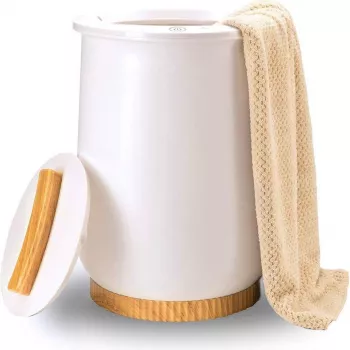
A towel warmer with a wood handle adds comfort and practicality to daily routines: towels feel inviting after showers, damp fabrics dry faster, and the wood handle makes it simple to move the unit without compromising the bathroom’s look. Below is what to expect from a large towel warmer, where it fits best, how to use it safely, and how to keep it performing well.
What Makes a Wood-Handle Towel Warmer Different
A wood-handle towel warmer stands out for both function and style. The handle offers a more comfortable grip when you need to reposition the warmer, move it to another room, or tuck it away between uses—especially helpful when the exterior is warm.
Beyond looks, the real upgrade is the “right now” comfort: stepping out of the shower to a warm towel helps avoid that cold, clammy moment in winter or in air-conditioned homes. And because warm air encourages moisture to evaporate, frequently used towels and robes can dry faster, which often helps reduce lingering damp smells when paired with good laundry habits.
Design-wise, the mixed-material feel (wood plus a metal/plastic body depending on the model) pairs naturally with modern, Japandi, and other texture-forward bathrooms where a purely utilitarian appliance would feel out of place.
Best Uses Around the Home
A large towel warmer isn’t only for the main bath. It’s a flexible comfort tool that can make routines feel easier and more polished:
- Post-shower towels: Warm and ready without waiting for a whole-room heater to catch up.
- Bathrobes and loungewear: A quick pre-warm before bedtime or early mornings.
- Guest bathrooms: A hotel-like touch visitors notice immediately.
- Nursery and kids’ bath time: Keeps towels comfortably warm for little ones (with careful placement and cord management).
- Pool, hot tub, or gym corner: Helps reduce the chill after swimming or workouts when placed in a dry, indoor area.
Size and Capacity: Getting the “Large” Benefit
The main advantage of a large towel warmer is capacity: it can handle bigger bath towels or multiple smaller towels at once. For best results, avoid overstuffing—heat needs space to circulate. Thick or plush towels usually take longer to feel evenly warm, and the way you fold matters; looser folds warm more consistently than tight rolls.
Think about your daily load. A solo user may only want one towel at a time, while a shared household might rotate towels in batches to keep them warm without compressing everything together. It also helps to plan a nearby landing zone—a small stool, shelf, or hook—so towels can move in and out smoothly without ending up in a damp pile.
Quick Capacity Planning Guide
| Household |
Typical Load |
Tip for Even Warming |
| Solo / couple |
1–2 bath towels or 1 towel + robe |
Loosely fold and leave a little air space |
| Family |
2–4 towels (staggered) |
Warm in batches rather than compressing everything |
| Guest-ready |
1–2 plush towels + hand towel |
Pre-warm shortly before guests arrive |
Where to Place It for Comfort and Safety
Placement is where convenience meets safety. Set the warmer on a stable, level surface with clearance around vents and openings so heat doesn’t build up in a tight pocket. In bathrooms, keep it out of direct spray and away from standing water or wet floors—generally outside the tub/shower splash zone.
Route the power cord so it won’t be pulled, pinched, or tripped over. If the outlet is awkwardly placed, cable clips can help keep the cord tidy along the vanity or baseboard. Also allow airflow; don’t push the warmer tightly into a corner or under hanging fabric that might block ventilation.
For broader electrical safety basics, the NFPA’s guidance on Electrical Safety in the Home is a helpful reference. And because bathrooms are naturally humid, it’s useful to follow moisture-prevention practices like those outlined in the EPA’s Mold and Moisture guidance.
Simple Routine for Great Results
A towel warmer performs best with towels that are clean and only lightly damp. Heavily soaked towels take longer and may warm unevenly because the outer layers can feel warm while the center stays cool. Before placing towels inside, shake them out and loosely fold them—avoid tight rolls that trap cooler pockets of air.
Care, Cleaning, and Keeping Odors Away
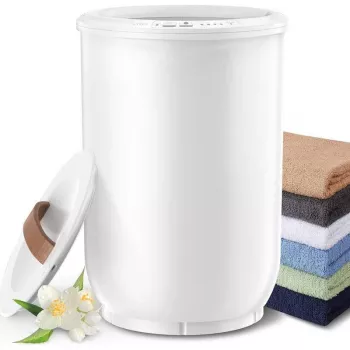
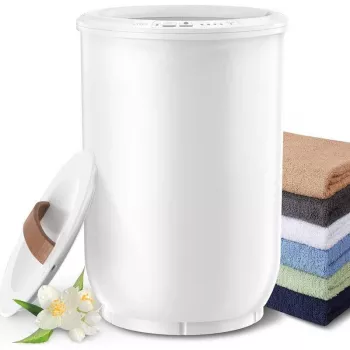
If warm towels are a daily comfort priority, the Large Bathroom Towel Warmer with Wood Handle is designed to make that routine simple. The large format supports bigger towels (or multiple smaller ones), while the wood handle detail makes it easier to move and adds a natural, elevated look.
For a more organized self-care corner, pair it with streamlined styling tools storage like the Hair Dryer Stand with Vertical Storage Rack, so countertops stay clear and your get-ready flow feels calmer.
At-a-Glance
FAQ
How long does it take to warm a towel?
It depends on towel thickness and how tightly it’s folded. Loosely folded towels warm faster and more evenly, while thicker towels typically take longer to feel warm throughout.
Can a towel warmer help reduce damp smells?
Regular warming and drying can reduce lingering dampness that contributes to odors. It doesn’t replace proper laundering and full drying, and towels shouldn’t be left inside the warmer for extended periods.
Is it safe to use a towel warmer in a bathroom?
It can be safe when used on a stable surface outside splash zones, with cords kept dry and out of walkways. Allow ventilation and follow the manufacturer’s placement and operating instructions.
Recommended for you







Leave a comment