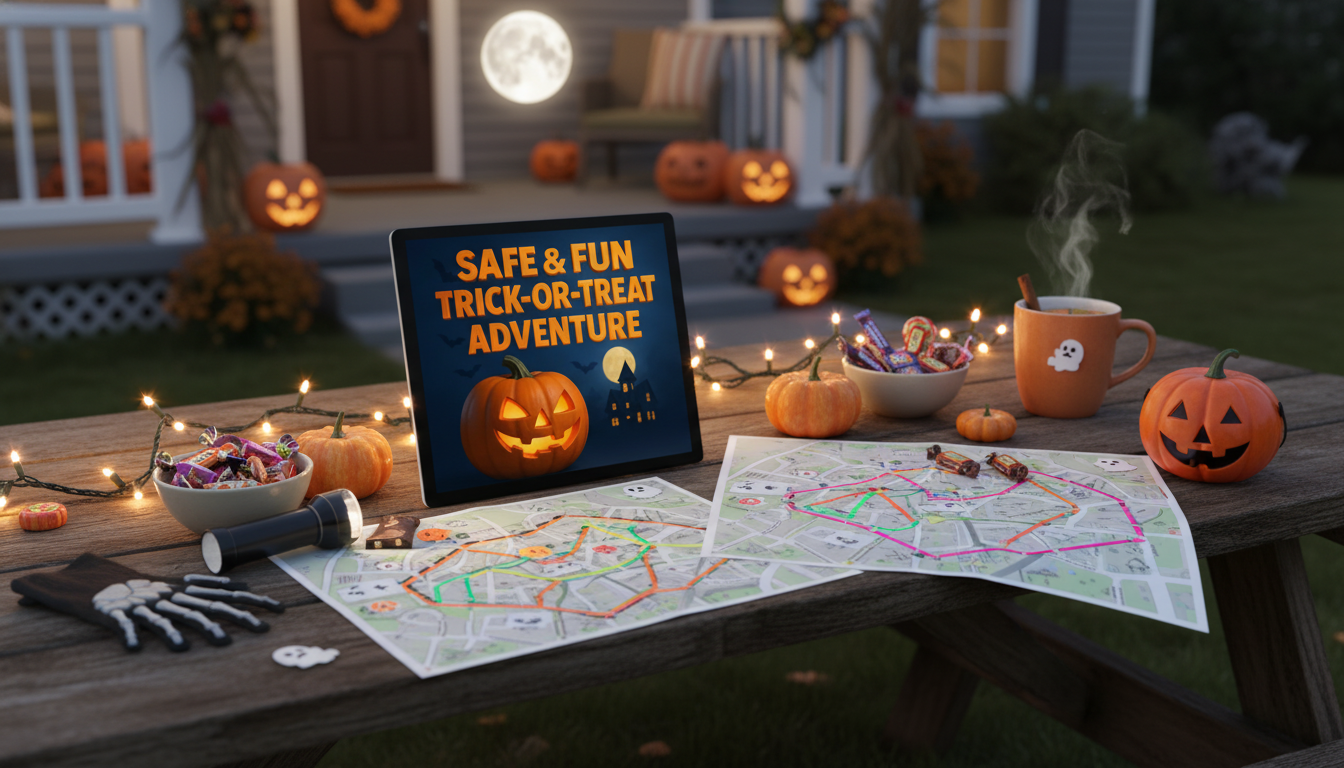
Safe & Fun Trick-Or-Treat Adventure: Build a Family Safety Route List
A great Halloween night feels spontaneous, but the safest ones are planned. A simple route list helps families choose well-lit streets, avoid traffic pinch points, keep groups together, and make quick decisions if weather or crowds change. Use the steps below to map a kid-friendly loop, set meeting rules, and keep the fun going from the first doorbell to the last candy check.
Start with a “safe fun” plan before costumes go on
Before anyone grabs a candy bucket, set a few rules that are easy for kids to remember and easy for adults to enforce. When expectations are clear, the walk stays relaxed—especially when it gets dark and busy.
- Pick the time window (start/end) based on daylight, school-night bedtime, and local trick-or-treat hours.
- Decide the group structure: one adult per small cluster of kids, plus a designated “sweep” adult at the back.
- Set a boundary rule: only visit homes with porch lights on (or confirmed participating homes); skip dark houses and isolated areas.
- Choose a communication method: charged phones, shared location (if used), and a written card in each child’s pocket with caregiver name/number.
- Prepare for visibility: reflective tape, glow sticks, and a small flashlight per adult; avoid masks that block vision.
- Confirm allergy and dietary needs ahead of time (trade bowl at home, non-food options, or a separate stash bag).
For a ready-to-use, family-friendly template that turns these ideas into a simple plan you can print or save on your phone, see the Safe & Fun Trick-Or-Treat Adventure Halloween Ebook.
Map a route that minimizes risk and maximizes fun
A great route is compact, predictable, and easy to adjust. The goal is fewer street crossings, fewer “Should we go this way?” moments, and more doors in less time.
- Choose a compact loop (or out-and-back) that keeps the group near the starting point and makes it easy to end early.
- Prioritize sidewalks, cul-de-sacs, and low-speed residential streets; avoid arterial roads and complex intersections.
- Identify safe crossing points with good sightlines; plan to cross as a group at the same spots every time.
- Mark “rest stops” (friend’s house, community center, well-lit corner) for quick costume fixes and water breaks.
- Plan the order: start near home for early excitement, then move to the densest cluster of decorated houses to reduce walking in the dark.
- Build a weather pivot: a shorter version of the route and an indoor backup (party games, movie, candy swap) if conditions worsen.
Trick-or-Treat Safety Route List (Copy/Paste and Customize)
| Item |
What to write down |
Why it matters |
| Start point |
Address + nearest cross street |
Clear meetup for late arrivals and an easy return |
| Route type |
Loop / Out-and-back / Two mini-loops |
Simplifies supervision and prevents kids from drifting |
| Planned streets |
Street names in order |
Reduces on-the-fly decisions near traffic |
| Crossing points |
Exact intersections to cross |
Keeps crossings predictable and safer |
| No-go zones |
Busy roads, dark blocks, isolated alleys |
Avoids the highest-risk areas |
| Rest stops |
2–3 well-lit stops with addresses |
Water, bathroom, quick regroup |
| Meeting spots |
Primary + backup spot |
Fast reunification if separated |
| Emergency plan |
Who calls, where to go, local non-emergency number |
Everyone knows the next step under stress |
| End time rule |
Hard stop time + “last house” cue |
Prevents over-tired kids and rushed walking |
Make the walk safer: traffic, visibility, and group rules
On Halloween, drivers may be distracted, streets may be crowded, and sightlines can be blocked by parked cars and decorations. Use a few repeatable habits to lower risk without dampening the excitement.
If temperatures drop, a warm layer can make the difference between a fun loop and a rushed walk home. A comfy option like the Funny Design Women’s Cropped Hoodie can be easy to throw on over a costume while still keeping movement comfortable.
Choose houses wisely without losing the Halloween magic
For more guidance from trusted safety organizations, review seasonal tips from Safe Kids Worldwide and the National Safety Council.
Candy and allergy checks: a simple after-walk routine
Setting out a simple sorting station can make the routine feel special. A small countertop container like the Striped Ceramic Seasoning Jar with Spoon can hold “trade tokens,” stickers, or non-food treats if your family likes to mix in alternatives.
Printable planning help for a smooth, kid-friendly adventure
If you want a step-by-step, fill-in guide you can reuse each year, the Safe & Fun Trick-Or-Treat Adventure Halloween Ebook is designed to make planning fast while keeping the night flexible.
For additional public health reminders (like visibility and safe behaviors around traffic), you can also consult the CDC.
FAQ
How long should a trick-or-treat route be for young kids?
Aim for about 30–60 minutes (often 0.5–1.5 miles), ideally as a loop so you’re never far from home. Keep a shorter backup route ready for cold weather, big crowds, or early fatigue.
What should be on a trick-or-treat safety route list?
Include the start point, planned streets in order, exact crossing points, no-go zones, 2–3 rest stops, primary and backup meeting spots, emergency contacts/roles, and a clear end-time rule.
How can costumes be made safer without ruining the look?
Add reflective details or glow accessories that match the costume theme, choose secure shoes, and keep hems off the ground. Consider face paint or a mask that doesn’t block vision, and carry a small light that complements the character.
Recommended for you










Leave a comment