Speak Up: Build the Confidence to Talk to Anyone
Talking to someone new can feel risky: the fear of awkwardness, rejection, or “saying the wrong thing” often blocks the first sentence. Confidence isn’t a personality trait reserved for a few; it’s a set of skills that can be practiced in small, repeatable steps. The goal is steady progress—learning how to start, keep, and end conversations comfortably while staying true to your style.
What Social Confidence Really Is (and What It Isn’t)
Social confidence is the ability to act even when nerves show up; it’s not the absence of anxiety. The goal isn’t to “never feel awkward”—it’s to keep moving while you feel it.
Confidence grows from evidence: repeated experiences of initiating, responding, and recovering from small missteps. That “evidence” mindset aligns with self-efficacy, a well-studied concept describing how strongly you believe you can handle a situation based on experience and learning (APA Dictionary of Psychology: self-efficacy).
Charisma is optional; clarity, warmth, and consistency matter more than being “interesting.” And one awkward moment doesn’t define a conversation—repair skills (acknowledging, redirecting, asking a question) usually matter most.
Common Blocks That Make Conversations Hard
Most conversation anxiety comes from a handful of predictable thought patterns:
- Mind-reading: assuming others are judging, bored, or annoyed without real evidence.
- Perfection pressure: expecting every line to land instead of aiming for connection.
- Over-focusing inward: monitoring how you look/sound rather than listening.
- All-or-nothing thinking: labeling an interaction as a failure if it’s not instantly smooth.
- Avoidance loops: skipping interactions reduces short-term stress but strengthens long-term fear.
If fear feels intense and persistent—especially when it affects work, school, or relationships—it may overlap with social anxiety. Helpful background and support options are outlined by the National Institute of Mental Health (NIMH).
A Simple Conversation Framework That Works Anywhere
When you’re not sure what to say, structure helps. A reliable flow looks like this:
- Start with context: a quick, neutral opener tied to the setting (event, shared task, environment).
- Use a “two-step” follow-up: (1) ask a question, then (2) reflect a detail back to show you heard it.
- Balance turns: aim for short shares plus a question rather than long monologues.
- Keep safe transitions ready: “That reminds me…”, “Speaking of…”, “What’s your take on…?”
- End cleanly: signal closure (“Good talking with you”) and add a next step if appropriate.
Example: “This line is moving faster than I expected. Have you tried this place before?” (question) “Oh, you usually come on weekends—makes sense.” (reflection) “What do you usually order?” (next question).
Build Confidence with Micro-Challenges (Low-Stakes Reps)
Big personality changes aren’t required. Small, frequent reps build the evidence your brain needs to relax.
- Set tiny targets: one greeting, one question, one compliment, or one follow-up each day.
- Track effort, not outcomes: success = initiating or staying present, not getting a perfect response.
- Practice recovery lines: “Lost my train of thought—anyway…” or “Let me rephrase that.”
- Use exposure stacking: start with quick interactions (cashier, neighbor), then longer chats (coworker, classmate), then higher-stakes settings (networking, dates).
- Reward consistency: a small reward after completing the day’s challenge builds momentum.
7-Day Speak-Up Practice Plan
| Day |
Micro-challenge |
Example line |
Quick reflection |
| 1 |
One greeting |
“Hey—how’s your day going?” |
What did you do despite nerves? |
| 2 |
One context opener |
“This place is busier than I expected—have you been here before?” |
What felt easier than expected? |
| 3 |
Two follow-up questions |
“How did you get into that?” |
Did listening reduce pressure? |
| 4 |
One short personal share |
“I’m trying to get better at meeting new people—what brought you here?” |
What did you learn about the other person? |
| 5 |
One compliment + question |
“That’s a great point—what made you think of it?” |
How did warmth change the tone? |
| 6 |
One small repair |
“I explained that poorly—what I mean is…” |
What happened after the repair? |
| 7 |
Start + end a conversation |
“Nice talking with you—enjoy the rest of your day.” |
What’s one skill to repeat next week? |
What to Say When You Freeze
Freezing is common—your mind isn’t “broken,” it’s overloaded. Use a simple reset.
Turn Practice into a Repeatable System
Small upgrades to your routine can also help you feel more put-together before social plans—whether that means simplifying your morning setup with a Hair Dryer Stand with Vertical Storage Rack or tightening up grooming with a Professional Electric Hair Clipper and Beard Trimmer Set for Men – Cordless Grooming Kit. If hosting friends is part of your practice plan, a warm, calming space—like one styled with a Handmade Wabi Sabi Rattan Pendant Light—can make conversation feel more natural.
Digital Guide and Checklist: Speak Up
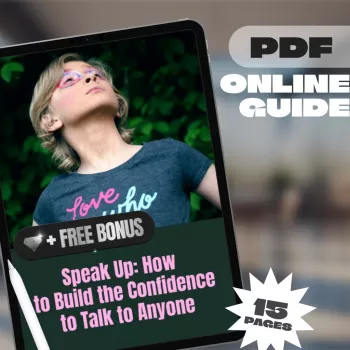
For a guided plan focused on building confidence to talk to anyone, see: Speak Up: How to Build the Confidence to Talk to Anyone – Digital Guide and Self-Growth Checklist.
FAQ
How do you start a conversation with someone you don’t know?
Use a context-based opener (the location, event, or shared task) and follow it with one simple question. Keep it short, friendly, and easy to answer.
What if the conversation gets awkward or there’s a long pause?
Use a quick repair line (“I blanked for a second”), then ask a follow-up question or reference something in the environment. If it’s not flowing, end politely—finishing well protects confidence.
How long does it take to feel more confident socially?
With consistent low-stakes practice, many people notice improvement over a few weeks. Track initiations and follow-ups rather than expecting every conversation to feel smooth.
Recommended for you













Leave a comment