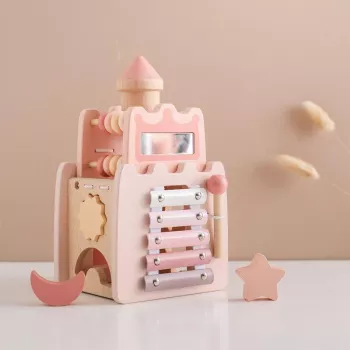
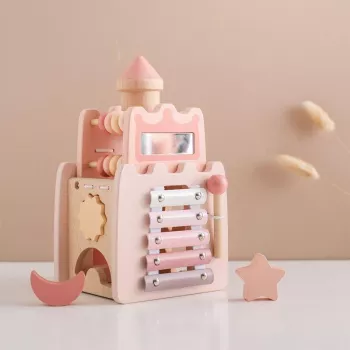
A wooden stacking and puzzle set can do more than keep little hands busy—it can support early problem-solving, coordination, and language-building through simple, repeatable play. This Montessori-style castle set blends stacking, shape play, and puzzle-style fitting so it can grow with a child’s skills, from basic sorting to imaginative castle-building.
What this castle stacking set includes
This 5-in-1 castle toy is designed to feel familiar quickly (so kids will return to it) while still offering new challenges as skills improve.
- Five play modes in one compact toy, built for repeated practice and increasing difficulty.
- Castle-themed pieces that work for open-ended building and for structured sorting/puzzle tasks.
- Wood construction for a heavier, more stable feel during stacking than many lightweight plastic sets.
- Works well for independent play, parallel play with siblings, or guided play with an adult modeling the next step.
Skills supported through Montessori-style play
Montessori-style play leans on simple materials, child-led exploration, and hands-on repetition. With a stacking-and-puzzle set, that often translates to small, meaningful skill gains over time—without needing batteries, screens, or complicated instructions.
- Fine motor control: grasping, pinching, placing, and aligning pieces builds hand strength and precision.
- Hand–eye coordination: stacking and fitting pieces into correct spaces reinforces visual tracking and controlled movement.
- Spatial reasoning: learning which piece fits where (and how shapes rotate) supports early geometry thinking.
- Executive function: planning a build, trying again after a fall, and finishing a puzzle supports focus and persistence.
- Early language: naming colors, shapes, sizes, and positions (on, under, next to, tall, short) during play.
- Social-emotional growth: turn-taking, waiting, and coping with “try again” moments in a low-stakes setting.
For general toy-selection guidance and safety reminders, see the American Academy of Pediatrics’ toy tips and the U.S. Consumer Product Safety Commission toy safety resources. For a quick overview of the Montessori approach, the American Montessori Society provides a clear introduction.
Play setups by age and stage
Instead of focusing on a strict age label, it helps to match the setup to what a child can do right now, then nudge forward by one small step.
- Early stage: introduce a few large pieces at a time; demonstrate stacking two pieces and let the child imitate.
- Sorting stage: offer all pieces and invite matching by color, shape, or size; keep directions simple and consistent.
- Puzzle stage: start with the easiest board/fit activity; point to the outline and guide the first placement if needed.
- Building stage: suggest “build a tall tower” or “make a castle gate” to encourage planning and creativity.
- Challenge stage: add constraints like “use only three pieces” or “copy this pattern” to increase difficulty without frustration.
- Routine idea: keep the set on a low shelf and rotate it in and out weekly to maintain interest.
Safety, materials, and care
Wood toys are loved for their weight and durability, but they still deserve basic checks and simple upkeep—especially when a toy is used daily.
- Choose toys with smooth edges and solid construction to reduce splinters and breakage risks during active play.
- Use only age-appropriate pieces; avoid offering small parts to children who still mouth objects heavily.
- Supervise during early use, especially while learning to stack higher structures that can topple.
- Clean by wiping with a slightly damp cloth; avoid soaking wood and avoid harsh cleaners.
- Store in a dry place; prolonged moisture can warp wood and affect fit for puzzle-style components.
At-a-glance details
Use this quick snapshot to compare basics—material, play styles, and current availability.
Product snapshot
| Item |
Detail |
| Product |
5-in-1 Baby Wooden Montessori Castle Stacking Blocks Puzzle Game |
| Material |
Wood (toy-grade finish varies by batch; confirm on the product page) |
| Play styles |
Stacking, sorting, puzzle fitting, pattern play, imaginative building |
| Best for |
Fine motor skills, problem-solving, early shape/size concepts |
| Price |
$39.67 USD |
| Availability |
In stock |
How to get the most learning from a simple toy
The biggest “upgrade” usually isn’t a more complex toy—it’s a small change in how the adult sets up and supports the play. Aim for calm pacing, short prompts, and plenty of time for the child to attempt, fail safely, and try again.
When this set makes a good gift
Shop in-stock picks
FAQ
What age is a wooden stacking and puzzle set best for?
Many children benefit once they can stack two blocks, pick up and place pieces with intent, and show interest in simple “match and fit” play—often in the toddler range. Always follow the product’s stated age guidance, and supervise closely if a child is still in a strong mouthing phase.
How can Montessori-style play be used with stacking blocks?
Keep it child-led: set out a few pieces, demonstrate one simple action, then let the child explore with minimal correction. Helpful prompts include “Where does it go?”, “Turn it,” and “Try again,” while naming real concepts like “corner,” “edge,” “tall,” and “under.”
How should wooden toys be cleaned safely?
Wipe with a slightly damp cloth, using mild soap if needed, then dry fully. Avoid soaking the wood or using harsh chemicals, and store the toy away from prolonged moisture to help prevent warping.
Recommended for you









Leave a comment