A ceiling-mounted cargo hammock is an easy way to reclaim seat pockets, footwells, and center consoles—without giving up comfort. By turning the “dead space” near the headliner into usable storage, a double-layer roof organizer keeps lightweight essentials in one predictable place. The added compartments help limit the classic road-trip problem: items rolling to one side during turns, braking, and quick lane changes.
What a ceiling cargo hammock organizer does
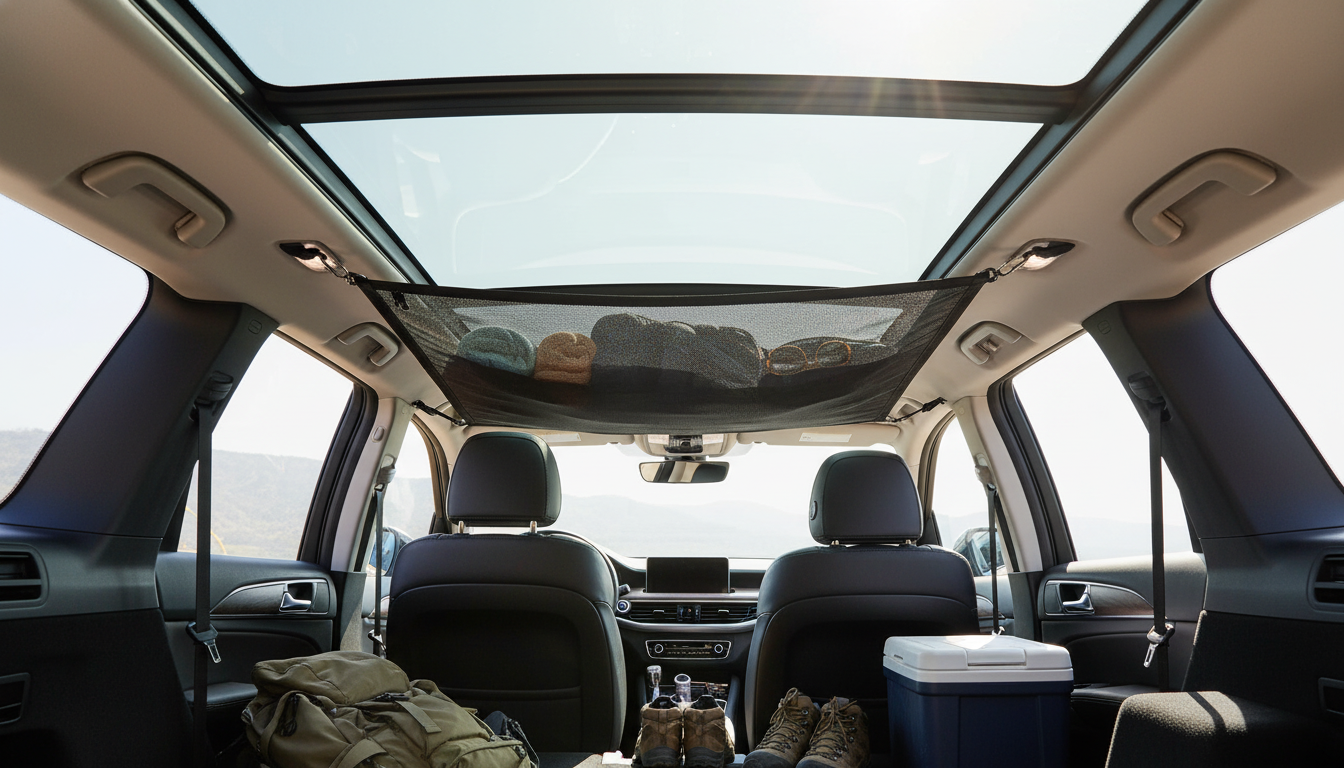
Most vehicles have plenty of overhead space that goes unused. A ceiling cargo net (sometimes called a roof organizer hammock) stretches between four anchor points to create a stable, flexible shelf for soft goods and daily travel items.
- Uses unused headliner space to store lightweight items and soft goods without taking up passenger legroom.
- Keeps frequently used travel items accessible from the front or second row (vehicle layout dependent).
- Helps reduce cabin clutter by grouping loose items into one overhead zone.
- Double-layer design supports separating flat items (maps, wipes, napkins) from bulkier soft items (jackets, blankets).
For families, commuters, and rideshare drivers, that overhead “home base” can make the cabin feel calmer—especially when paired with habits like putting the same item types in the same areas every time.
Double-layer storage and compartments: practical ways to organize
Not all cargo nets behave the same once you start driving. The advantage of a double-layer layout is that it encourages you to store by shape and weight, which naturally reduces sagging and shifting.
- Top layer: best for flatter, lighter items to keep the profile low (paperwork, small towels, thin pouches).
- Lower layer: better for compressible items (hoodies, scarves, kids’ plush toys) that won’t become hard projectiles.
- Compartments: help prevent items sliding to one end during turns and braking.
- A good routine: dedicate one section to “quick-grab” items and another to “arrive-and-unpack” items.
Suggested loadout by item type
| Item type |
Where to place it |
Why it works |
| Light jackets / sweaters |
Lower layer (centered) |
Soft and compressible; stable when centered |
| Blanket |
Lower layer (spread out) |
Distributes weight and reduces sagging |
| Wet wipes / tissues |
Upper layer (near access side) |
Fast access without digging |
| Charging cables / small accessories |
Compartmented area or pouch inside net |
Reduces tangles and keeps items grouped |
| Kids’ toys (soft) |
Lower layer (toward rear) |
Less distraction for driver; still reachable on stops |
| Paper documents / maps |
Upper layer (flat) |
Prevents creasing and keeps visibility of contents |
Fit and compatibility checks before buying
Before ordering a roof organizer, it’s worth taking a minute to confirm it can anchor securely and sit high enough to stay out of the way.
- Confirm there are four secure mounting points (typically grab handles, headrest posts with straps, or dedicated anchors depending on vehicle).
- Measure approximate roof span between mounting points to avoid overstretching or excessive slack.
- Check headroom: the net should sit high enough to avoid brushing taller passengers’ heads.
- For vehicles with sunroof or roof consoles, ensure the net won’t interfere with operation, airflow, or lighting.
If your vehicle has a panoramic sunroof, consider how often it’s used. Some drivers prefer a net that sits behind the front row only, keeping the sunroof area clear while still adding overhead storage.
Installation overview and best practices
Most ceiling nets install in minutes, but the “feel” of the hammock depends on tightening and centering.
- Attach all four corners loosely first, then tighten gradually to level the hammock.
- Center the net so weight is distributed evenly; avoid loading heavy items on one side.
- Keep items behind the driver’s line of sight; do a seated visibility check after loading.
- Re-tighten straps after the first drive as webbing may settle.
A quick test drive around the block is usually enough to reveal whether the net needs a small tweak to sit flatter or reduce bounce.
Safety and comfort tips for daily driving
Any interior storage solution should support safer driving by reducing loose items and minimizing distraction. For general guidance on distraction risk, see the NHTSA resource on distracted driving. For broader roadway safety context, the CDC motor vehicle safety overview is also helpful.
Care, cleaning, and long-term use
If the goal is quick cabin decluttering with better control over shifting items, the Car Ceiling Cargo Net Double-Layer Roof Organizer Hammock with Compartments is designed to turn overhead space into separated storage. The double-layer layout and compartmented sections are intended to keep flatter items visible while giving soft goods a stable “shelf” that doesn’t steal legroom.
At-a-glance details
More in-stock picks that pair well for travel
FAQ
Will a ceiling cargo net fit my vehicle?
Most vehicles can work if you have four secure anchor points such as grab handles or strap-friendly headrest posts. Measure the span between mounting points and double-check clearance for sunroofs and roof consoles so the net can sit tight without interfering.
What should not be stored in a roof cargo hammock?
Avoid heavy, hard, sharp, or breakable items. Stick to lightweight, soft goods and keep the load high enough that it doesn’t block rear-view mirror visibility or reduce passenger headroom.
How do you stop the net from sagging or shifting while driving?
Install it centered, tighten straps evenly, and distribute weight across the middle rather than one side. Use compartments for smaller items and re-tighten after the first drive to account for strap settling.
Recommended for you








Leave a comment