52-Inch Bird Cage with Rolling Stand: Space, Safety, and Everyday Convenience
A tall cage on a wheeled stand can make daily bird care easier while giving a companion bird room to climb, perch, and play. The right setup balances interior space, bar spacing, sturdy construction, simple cleaning, and smooth mobility so the cage works for both the bird and the household routine. For more guidance, see NEW 64-inch Play Open Top Bird Cage with Detachable ….
What a 52-inch cage with a rolling stand changes day to day
Adding height and mobility tends to reshape routines in small but meaningful ways, especially in busy households where the cage location needs to flex with light, noise, and traffic. For further reading, see Large Bird Cage with Rolling Stand, 54 inch Metal Bird Cage ….
- Mobility for light, noise, and family time: roll the cage to a brighter spot in the morning and to a quieter corner for rest, without lifting.
- Easier floor cleaning: the stand lifts the cage off the ground, helping reduce scattered seed and dust buildup around baseboards.
- More vertical territory: height supports climbing and multiple perch zones so birds can choose distance, warmth, and activity levels.
- Better access for care: a raised cage can reduce bending during water changes, food refills, and spot-cleaning.
Key size details to confirm before buying
“52-inch” often describes overall height, not usable living space. Before checkout, confirm the measurements that matter most for comfort and safe movement.
- Interior dimensions matter more than overall height: a tall cage should still have enough width and depth for wing extension and turning without brushing bars.
- Bar spacing must match the bird’s head size: too wide risks escapes or injury, too narrow limits visibility and climbing.
- Door size and placement affect daily handling: look for doors large enough for hands, bowls, and perches, and positioned to avoid corner-reach issues.
- Plan clearance: allow space behind and beside the cage for wall protection, cord management, and easy roll-out for cleaning.
Quick fit checklist for common household constraints
| Item to measure |
What to check |
Practical target |
| Floor footprint |
Stand base vs. intended spot |
Leave a few inches on each side for rolling and cleaning |
| Door swing / access |
Room to open cage doors fully |
No collision with walls, furniture, or curtains |
| Ceiling and shelf clearance |
Total height on stand |
Avoid tight overhead spaces that trap heat or dust |
| Rolling path |
Thresholds, rugs, narrow hallways |
Smooth route without lifting the cage |
Build and safety features worth prioritizing
A rolling stand is only as useful as it is stable. Look for details that reduce tipping risk, prevent door mishaps, and stand up to everyday wear.
- Stable stand design: a wide base and a low center of gravity reduce wobble when birds climb or flap.
- Locking casters: wheels should roll smoothly but lock firmly to prevent drifting during play or when doors are open.
- Secure latches: simple, strong closures help prevent clever birds from pushing doors open.
- Non-toxic, bird-safe finishes: avoid flaking coatings and inspect for sharp edges at joints and around doors.
- Feed-door and bowl access: external-access feeders can reduce escapes during refills, especially with active birds.
For broader bird health and safety guidance, review veterinary and welfare resources such as the Association of Avian Veterinarians (AAV) and the ASPCA bird care overview.
Comfort setup: perches, bowls, and enrichment
A tall cage feels more “livable” when the interior is arranged to support movement without forcing birds to squeeze past toys or cling to bars for balance.
- Perch variety supports healthy feet: mix diameters and textures (natural wood, rope, platform) and avoid relying only on smooth dowels.
- Place perches to protect tail feathers: keep main resting perches far enough from bars to prevent rubbing and feather wear.
- Create zones: one area for feeding, another for play, and a calmer sleeping corner to reduce stress.
- Rotate toys: change a few items weekly to keep interest while avoiding overcrowding the flight path.
- Use liners that simplify cleaning: paper liners are quick to replace and make droppings monitoring easier.
If the cage will be moved to follow daylight, consider how the room lighting supports a consistent routine. A softer, ambient fixture like the Handmade Wabi Sabi Rattan Pendant Light can help keep the area comfortably bright without relying on harsh glare.
Cleaning and maintenance with a rolling stand
Placement tips for light, temperature, and household safety
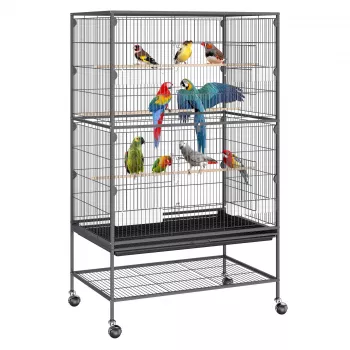
The 52-Inch Large Bird Cage with Rolling Stand is a tall, stand-mounted setup designed to support flexible placement and easier cleaning under and around the cage. The rolling stand adds convenience for households that rearrange spaces, vacuum frequently, or shift the cage to balance bright daytime activity with quieter rest periods.
At-a-glance product details
FAQ
Do rolling stands wobble or make noise on hard floors?
They can if the stand is narrow, the casters are low quality, or the cage weight is top-heavy. Choose a wide-base stand with locking casters, keep heavier items lower in the cage/stand area, and consider a thin mat if needed (as long as it doesn’t interfere with wheel locks).
How often should a large bird cage be cleaned?
A practical schedule is daily liner changes and fresh water, weekly bowl washing and bar/grate wipe-downs, and periodic deep cleaning. Cleaning frequency should increase for messy eaters, fresh-food diets, and homes with multiple birds.
Where is the safest place to position a bird cage in a home?
Place the cage in a well-lit, draft-free area away from kitchen fumes, direct HVAC airflow, and intense direct sun through windows. A wall-side position often helps birds feel secure, and cords or toxic plants should be kept completely out of reach.
Recommended for you












Leave a comment