Wooden animal puzzles made for little hands turn playtime into a calm, screen-free way to practice early problem-solving. With bright cartoon animals and chunky 3D pieces, this type of puzzle supports grasping, matching, and simple sequencing while keeping the activity short and satisfying for babies and toddlers. It’s the kind of toy that fits easily into real routines—after breakfast, before a nap, or during quiet play—without needing batteries, apps, or a big setup.
What makes 3D wooden animal puzzles different
Not all toddler puzzles feel the same. A 3D wooden board puzzle is designed to meet young children where they are—still building control, still exploring with their hands, and still learning how “parts” become a “whole.”
- Chunky, raised pieces are easier for babies and young toddlers to grasp than flat jigsaw pieces, especially when finger dexterity is still developing.
- Cartoon animal shapes help children recognize familiar creatures and connect images with names and sounds (cow, duck, fish), making the puzzle feel meaningful rather than abstract.
- Short, repeatable play sessions let kids finish, reset, and repeat without frustration—great for toddlers who prefer quick wins.
- A sturdy wooden board provides a stable play surface that supports controlled movements and more accurate placement.
Skills supported during everyday play
A simple animal puzzle can quietly reinforce multiple early skills at once. The goal doesn’t have to be “complete the puzzle perfectly”—it can be about exploration, attempts, and small successes.
- Fine motor practice: pincer grasp, hand strength, and controlled release when placing pieces into cutouts.
- Hand–eye coordination: aligning a piece’s edges to the matching slot.
- Early problem-solving: testing orientation, rotating pieces, and learning from trial and error.
- Language building: naming animals, describing colors, and using simple action words (jump, swim, fly).
- Attention and calm focus: a quiet activity that can fit into wind-down time or after-meal routines.
For a broader look at age-expected skills, the CDC’s developmental milestones can be a helpful reference when deciding what level of challenge to offer.
Age guidance and how to keep it engaging
The quickest way to keep a puzzle “fun” is to match the challenge to the moment. If a toddler is tired or overstimulated, fewer pieces can be the difference between calm focus and a full meltdown.
- Start with 1–3 pieces at a time for younger toddlers; add more pieces as confidence grows.
- Model one placement, then hand over a piece to encourage imitation and turn-taking.
- Use simple prompts like “Find the tail” or “Where does the duck go?” rather than giving the answer right away.
- Keep sessions brief; stopping while it’s still fun makes children more likely to return to it later.
Quick guide: ages, supervision, and play ideas
| Age range |
Typical setup |
How to play |
Adult supervision notes |
| 6–12 months |
1–2 large pieces at a time |
Name the animal; help place together; encourage touching and tapping |
Close supervision; confirm pieces are too large to fit in a child’s mouth; inspect for splinters or cracks |
| 12–24 months |
2–5 pieces |
Ask for matching by shape; let the child rotate and try; celebrate attempts |
Stay nearby; watch for mouthing and throwing; store after play |
| 2–3 years |
Full set |
Animal sounds, simple stories, sorting by habitat or color |
Check that the play area is clear of tripping hazards and that pieces stay intact |
Materials and safety checks to do before every use
Wooden puzzles are often chosen for their durability, but a quick check before play helps keep the experience safer—especially for babies who explore by mouthing and tossing.
For more on preventing choking, review the American Academy of Pediatrics guidance on choking prevention, and for general toy safety tips, the U.S. Consumer Product Safety Commission toy safety resources.
Play ideas that build learning without pressure
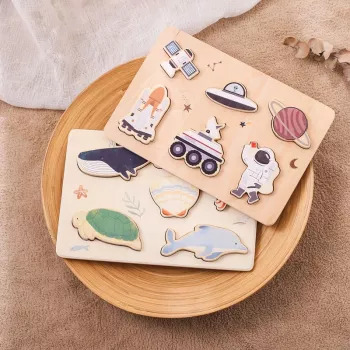
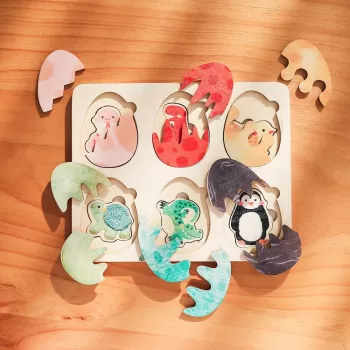
Baby Wooden 3D Cartoon Animal Puzzles is a simple wooden puzzle set featuring 3D cartoon animal pieces designed for small hands. It works well as a quick independent activity with nearby supervision or as a parent–child turn-taking game when you want something quiet and structured. It’s also an easy choice for gifting, travel play, or rotating into a toy shelf to keep activities feeling fresh.
More in-stock finds (giftable add-ons)
Care, storage, and making it last
FAQ
What age is a 3D wooden animal puzzle best for?
Many families find these puzzles work well from about 12–36 months with supervision. For younger toddlers, start with just a couple of pieces and gradually add more as matching and patience improve.
How can a baby use a puzzle if they can’t match shapes yet?
Use assisted play: name the animals, let the baby explore pieces by touching and turning, and guide placement hand-over-hand. The early win is practicing grasping and rotating—not perfect matching.
How should wooden puzzle pieces be cleaned safely?
Wipe with a slightly damp cloth; use mild soap if needed, and avoid soaking the wood. Let everything air-dry completely, and stop using the puzzle if paint starts peeling or the wood cracks.
Recommended for you









Leave a comment