100W USB-C to USB-C Fast Charging Cable (PD 3.0, QC 4.0, 5A): What It Does and Who It’s For
A high-power USB-C to USB-C cable can be the difference between slow “maintenance charging” and full-speed power delivery for phones, tablets, laptops, and accessories. This guide breaks down what a 100W (5A) USB-C cable is built to handle, how PD 3.0 and QC 4.0 relate to real-world charging, what to check before buying, and how to use a high-watt cable safely day after day.
What a 100W USB-C to USB-C cable is designed to handle
A 100W USB-C to USB-C cable is made for USB-C devices that can negotiate higher charging power. That “100W” rating typically refers to a maximum of 20V at 5A under USB Power Delivery (PD) profiles when everything in the chain supports it.
- Supports higher power transfer for USB-C devices that can negotiate fast charging.
- Rated for up to 100W output (commonly 20V/5A) when used with a compatible USB-C PD charger.
- Useful for laptops and tablets that draw more than typical phone-level wattage.
- Best results require the full chain to support it: charger + cable + device.
In practice, this kind of cable is most valuable when a device would otherwise be limited by a lower-rated (often 3A) cable, especially for laptops and power-hungry accessories.
PD 3.0 and QC 4.0 explained in practical terms
USB-C fast charging isn’t just about “plugging in”—it’s about communication. USB Power Delivery (PD) is the most common standard that lets the charger and device agree on a safe voltage and current level over USB-C. PD 3.0 is widely used across modern phones, tablets, handheld consoles, and many laptops.
- USB Power Delivery (PD) is the primary standard for fast charging over USB-C, letting the charger and device negotiate voltage/current safely.
- PD 3.0 is commonly used across modern USB-C phones, tablets, handheld consoles, and many laptops.
- QC 4.0 is compatible with USB-C power negotiation and is often found in fast-charging ecosystems for certain Android devices and chargers.
- If a device does not support fast-charging protocols, the cable still works, but charging speed may be limited by the device or charger.
For deeper standards details, the USB-IF documentation is the definitive reference (USB Power Delivery Specification). For Quick Charge specifics, Qualcomm provides an overview of the feature set and compatibility expectations (Qualcomm Quick Charge 4 Technology Overview).
Power and speed: what determines real-world charging performance
Charging performance depends on the negotiated power profile and the limits of each component. Wattage is simply voltage multiplied by current (W = V × A). A 5A cable makes higher wattage possible, but it never “pushes” power into a device on its own.
- Wattage is the result of voltage × current; a 5A cable enables higher wattage profiles when a charger/device supports them.
- A 100W cable does not automatically force 100W—devices draw only what they are designed to accept.
- Charging speed is constrained by the lowest-capability component: wall charger, power bank, device port, or the cable rating.
- For large devices (laptops/tablets), pairing with an appropriate USB-C PD charger is essential for fast charging.
Typical USB-C PD power levels and common device use-cases
| Power tier |
Common PD profiles (examples) |
Typical devices (examples) |
Notes |
| 18–30W |
9V/2A, 12V/2.5A |
Phones, small tablets |
Fast charging varies by brand; device controls intake. |
| 45–65W |
15V/3A, 20V/3.25A |
Tablets, ultrabooks, handheld consoles |
Good balance for travel chargers. |
| 90–100W |
20V/4.5A–5A |
Larger laptops, docks, high-draw gear |
Requires a 5A-capable cable and compatible charger/device. |
Compatibility checklist before buying or plugging in
Before assuming a cable will deliver laptop-level charging, confirm the basics. Many “charging issues” are simply mismatched components or an unexpected bottleneck.
Safety, heat, and durability basics for high-watt charging
Everyday use cases where a 100W USB-C cable helps
Care and troubleshooting tips
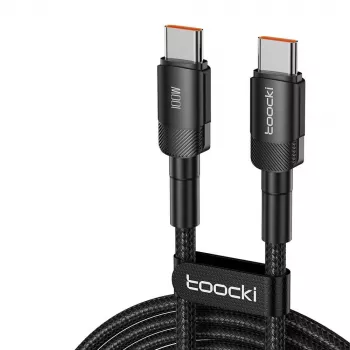
If you’re looking for a cable that’s built for higher-power USB-C charging, 100W USB-C to USB-C Fast Charging Cable with PD 3.0 & QC 4.0 – 5A Power is designed to support up to 100W (with compatible chargers and devices). It’s a practical fit as a primary laptop cable, a reliable travel spare, or the “one cable” that prevents 3A limitations from slowing down higher-draw devices.
More in-stock picks
FAQ
Will a 100W USB-C to USB-C cable charge a laptop safely?
Yes, when used with a USB-C PD charger and a laptop that supports USB-C charging. The laptop draws only the power it needs, so confirm the laptop’s required wattage and use a PD-capable charger that can meet it.
Does a 100W cable make a phone charge faster?
Only if the phone and charger support higher fast-charging profiles; otherwise the phone limits how much power it takes in. A 100W cable mainly helps by ensuring the cable isn’t the bottleneck.
Why is my USB-C fast charging not working even with a PD/QC cable?
Common causes include using a non-PD or low-watt charger, a device that doesn’t support the same fast-charging protocol, dirty or loose ports, or a USB-A adapter/cable setup that prevents proper USB-C power negotiation.
Recommended for you











Leave a comment