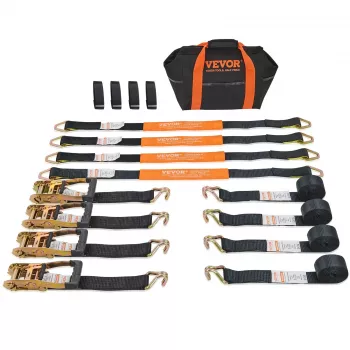
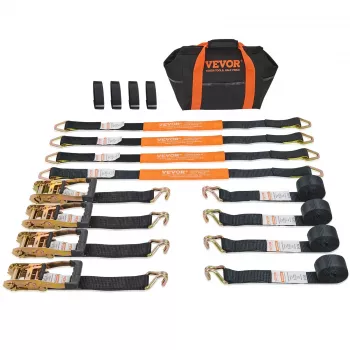
Keeping gear stable on a motorcycle, in a trunk, or on a small trailer comes down to two things: consistent tension and a buckle that won’t slip. This 4-piece ratchet strap set is designed to cinch loads firmly, reduce shifting during turns and braking, and make packing faster whether it’s soft luggage, tool bags, or boxed cargo.
What this strap set is built for
- Securing motorcycle luggage such as tail bags, duffels, dry bags, and tent rolls
- Stabilizing suitcases and boxes inside a car trunk to prevent sliding
- Bundling irregular items (sleeping pads, folding chairs, tripod cases) for travel and storage
- Quick tie-down tasks where a ratcheting buckle is preferred over elastic cords
- Adding multiple independent tie points instead of relying on a single long strap
Key details that matter on the road
- 4-piece set: multiple straps allow balanced, redundant securing points (use two to form an “X” over luggage)
- Ratchet tightening: fine, incremental tensioning helps reduce loosening from vibration compared with simple cam-only tightening
- Metal buckle: designed to hold tension under load and resist deformation from repeated tightening
- Compact storage: shorter tie-down straps are typically easier to pack into a pannier, under-seat compartment, or glove box
- Versatile anchoring: suitable for hooking or looping to luggage racks, grab rails, tie-down points, or trunk anchors (confirm compatibility with the strap ends and your anchor points)
Where ratchet straps outperform bungees and simple belts
- More controlled tension: helps prevent over-compressing soft luggage while still keeping it stable
- Less bounce: ratcheting tension reduces the springy movement common with elastic cords
- Better for odd shapes: cinches down bulky bundles that don’t stack neatly
- Repeatable setup: once a preferred routing is found, the same strap path can be reused for consistent packing
For riders dealing with vibration, wind buffeting, and repeated braking forces, a ratchet mechanism is often the difference between “still secure after 40 miles” and “needs adjustment at the first stop.” For broader safety context, the FMCSA cargo securement rules outline why stable restraint and preventing shifting matters during transport, even if you’re only moving personal gear.
Strap routing examples for motorcycles and luggage
Tail bag or duffel on the rear seat
Run two straps front-to-back and tighten evenly so the bag compresses slightly and can’t creep during acceleration. If the load is tall or top-heavy, add the second pair crosswise to resist side-to-side walk in corners.
Dry bag on a luggage rack
Place the bag on a non-slip pad if available, then use two straps in an “X” pattern. This routing helps prevent lateral drift when the rack is narrow or the bag’s surface is slick.
Helmet or jacket bundle for short stops
Loop straps through secure points on the bike and keep webbing away from hot exhaust and sharp edges. For a quick run into a store, a modest, even cinch is usually better than cranking down hard on a compressible bundle.
Car trunk suitcase restraint
Anchor to trunk tie-down rings and cinch until the suitcase no longer shifts when pushed firmly. Avoid crushing fragile contents by tightening gradually and checking what’s inside the bag before the final clicks.
Using ratchet straps safely (quick checklist)
- Inspect before each trip: look for fraying webbing, cuts, melted spots, bent hardware, or corrosion
- Protect edges: use a sleeve, cloth, or edge guard where webbing touches sharp corners
- Avoid heat and moving parts: keep clear of exhaust, chain, wheel, and suspension travel
- Tighten gradually and evenly: alternate between straps so the load stays centered
- Stop-and-recheck: verify tension after the first 5–10 minutes of riding/driving and after major bumps or rain
If you want more technical background on web tie-down behavior (stretch, abrasion, and inspection), the Web Sling & Tie Down Association (WSTDA) provides industry guidance that aligns well with real-world travel use.
Quick comparison: ratchet straps vs other common tie-down options
Choose based on load stability needs, how often the setup is reused, and whether vibration is a concern.
Tie-down option comparison for travel and motorcycle cargo
| Option |
Best for |
Limitations |
Typical use case |
| Ratchet straps (this set) |
Firm, vibration-resistant securing with adjustable tension |
Can over-tighten soft items if not careful; takes a bit longer than bungees |
Motorcycle luggage, trunk cargo, boxed items |
| Cam buckle straps |
Fast tightening for lighter loads |
May slip more under vibration or high load than ratchets |
Light luggage, securing sleeping pads, quick packing |
| Bungee cords |
Temporary holds and lightweight items |
Elastic bounce can shift loads; hooks can slip if not secured |
Short trips, light bundles, quick stopgap solutions |
| Rope / paracord |
Custom knots and odd anchor points |
Requires knot skill; tension can relax over time |
Camping bundles, general utility tying |
Care, storage, and longevity tips
Products in stock
FAQ
How tight should ratchet straps be on soft luggage?
Tighten until the bag can’t shift when pushed firmly by hand, then stop before seams, zippers, or contents start to deform. Use small ratchet increments and check both sides so the load compresses evenly.
Can these straps be used for motorcycle luggage racks and tail seats?
Yes, as long as the strap path avoids hot exhaust and sharp edges and the anchor points are secure. Use at least two straps for stability and recheck tension after the first few minutes of riding.
Why do straps loosen after riding or driving for a while?
Vibration, webbing settling, and load compression can reduce tension over time. Stop early to re-tension, confirm the webbing isn’t sliding over slick surfaces, and add edge protection where needed.
Recommended for you










Leave a comment