Why “no” triggers guilt (and why that doesn’t mean it’s wrong)
Saying “no” can land like a social risk, even when the request is inconvenient, expensive, or emotionally draining. Guilt often shows up first—not because you did something wrong, but because you’re interrupting an old pattern.
- People-pleasing patterns: Approval can feel like safety, so refusal can feel like danger—even when the request is unreasonable.
- Role conditioning: Caregivers, high achievers, and “reliable” friends often absorb an unspoken rule to be available.
- Fear of conflict: Guilt can work like a shortcut emotion that pushes you to agree quickly and avoid discomfort.
- Confusing boundaries with rejection: A boundary protects capacity; it isn’t a verdict on someone’s value.
- A healthy reframe: Guilt is information, not an instruction. Sometimes it signals growth pains rather than wrongdoing.
Long-term stress has real effects on the body and mood, which is why boundaries are more than “communication skills”—they’re prevention. The American Psychological Association and Mayo Clinic both highlight how chronic stress can affect sleep, energy, and overall health.
Signs a boundary is needed (before burnout decides for you)
Boundaries usually become obvious in hindsight—after resentment, overwhelm, or that “why did I agree to this?” feeling. Catching early signals makes saying no simpler and calmer.
- Resentment after saying yes, even to small requests.
- Overcompensating after saying no with long explanations, gifts, or extra favors.
- Chronic overwhelm: less sleep, more irritability, or dread around messages and invitations.
- Self-betrayal language: “I have to” or “I can’t disappoint them” replacing “I choose to.”
- Unequal reciprocity: support flows one way, while your needs are minimized or ignored.
The three-part boundary that keeps relationships intact
A strong boundary is short, steady, and repeatable. It’s not a persuasive essay—it’s a clear decision delivered respectfully.
- Part 1 — Clear decision: Say yes or no directly, without leaving the door cracked for debate.
- Part 2 — Brief reason (optional): One sentence is enough; avoid courtroom-level evidence.
- Part 3 — Next step: Offer an alternative only if it truly works (delay, smaller commitment, different format).
- Tone guidelines: calm, steady, kind. Apologizing is optional—don’t let it weaken the message.
- If pushed: repeat the decision, reduce details, and end the loop: “That won’t work for me.”
If you want a practical framework for assertive language, the NHS guide on how to be more assertive is a helpful reference for keeping your delivery clear and non-aggressive.
Guilt-free “no” scripts for common situations
Clarity is kinder than a confusing maybe. Excuses invite negotiation; boundaries set a limit. “I” statements keep the focus on capacity, not blame—and planning for pushback prevents you from getting pulled into explaining yourself into exhaustion.
Quick scripts that say no without over-explaining
| Situation |
Simple response |
If they push back |
| Last-minute request |
“I can’t do that today.” |
“I understand it’s urgent, and I still can’t.” |
| Workload overload |
“My plate is full, so I’m not taking on new tasks.” |
“Which priority should move, or should this wait?” |
| Family guilt |
“I’m not available this weekend.” |
“I know you’re disappointed. My answer is still no.” |
| Friend asks for a favor |
“I can’t help with that.” |
“I’m not able to. I hope you find another option.” |
| Invitation you don’t want |
“Thanks for thinking of me—I’m going to pass.” |
“No, but I appreciate the invite.” |
| Someone wants free emotional labor |
“I care about you, and I can’t talk about this right now.” |
“I’m going to step back. Let’s revisit when I have bandwidth.” |
How to stop feeling guilty after you say no
The moment after a boundary is where many people undo it—by sending a follow-up text, adding extra favors, or reopening the decision. Try these steps instead.
- Name the feeling: guilt, anxiety, or fear of being disliked. Labeling reduces intensity.
- Check the facts: did you break a commitment, or protect a limit? Those are different.
- Replace reassurance-seeking with self-trust: avoid follow-ups that reopen the decision.
- Practice discomfort tolerance: boundaries can feel awkward at first; that discomfort often fades.
- Repair without reversing: if delivery was sharp, repair tone (“I could’ve said that more gently”), not the boundary.
A workbook approach: practice confidence instead of waiting for it
Confidence tends to follow reps. A simple “practice system” turns boundaries into a skill instead of a personality trait you either have or don’t.
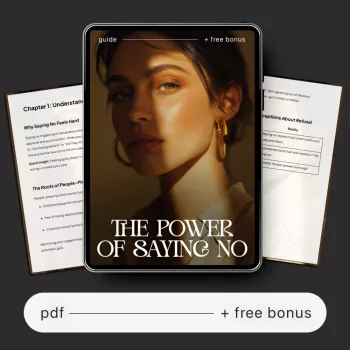
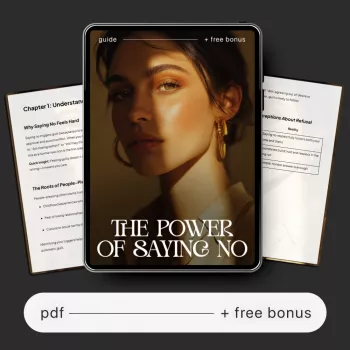
Digital download: The Power of Saying No workbook
If you want guided practice you can return to whenever a new “guilt hot spot” appears, The Power of Saying No – Guilt-Free Boundaries Guide (digital download workbook) is designed for repeat use—one relationship at a time or as a full reset.
Using boundaries in different relationships
When a boundary isn’t respected
Small environment shifts that support stronger boundaries
FAQ
How can saying no be kind without sounding cold?
Keep it clear and brief: a direct no, an optional one-sentence reason, and a warm tone. “Thanks for thinking of me—I’m going to pass” is often kinder than a hesitant maybe that creates confusion.
Why do I feel guilty even when my no is reasonable?
Guilt often comes from conditioning (people-pleasing roles, conflict avoidance), not from actual wrongdoing. Treat it as a signal that you’re changing a pattern, then ground yourself by checking the facts and resisting follow-up reassurance texts.
What if someone keeps pushing after I say no?
Use the broken-record approach: repeat your decision with fewer details—“That won’t work for me.” If pushing continues, add a consequence (ending the conversation, leaving, or pausing contact) and follow through consistently.
Recommended for you












Leave a comment