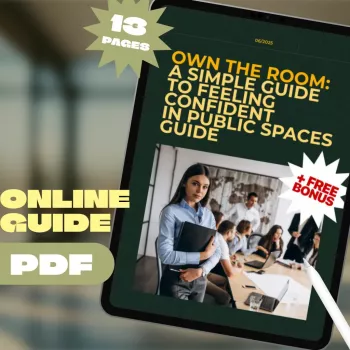
Own the Room: A Simple Guide to Feeling Confident in Public Spaces (eBook PDF)
Public spaces can flip on self-consciousness fast: the sensation of being watched, the urge to rush, and the mental noise of “Am I doing this right?” This guide is built around practical, low-pressure skills that show up in your body, voice, and choices—without forcing a new personality. Think calm presence, not flawless performance. If stress is hitting your body hard in social settings, it can help to understand how stress responses work overall; the American Psychological Association offers a clear overview.
What “owning the room” actually looks like
“Owning the room” isn’t about taking over attention—it’s about looking and feeling steady while you move through everyday moments. Confidence is most visible as behavior: posture that’s upright but not rigid, a pace that isn’t rushed, eye contact that lands briefly, and decisions that don’t look apologetic.
- Presence over performance: aim for grounded calm rather than trying to impress.
- Small wins that compound: enter, pause, scan, choose a spot, then engage.
- Separate being noticed from being judged: people can see you without evaluating you.
When your focus shifts from “How do I look?” to “What am I doing next?” your mind gets quieter—and your body naturally steadies.
Quick reset tools for when anxiety spikes in public
Anxiety often shows up as speed: fast breathing, fast walking, fast thinking. The fastest resets slow the body first, then the mind follows. Try longer exhales, relax your jaw, and drop your shoulders by a half-inch—subtle cues that interrupt the “threat” loop.
- Downshift breath: inhale through your nose, then exhale longer than you inhaled.
- Name what’s happening: label sensations (“tight chest,” “warm face,” “racing thoughts”).
- Micro-grounding: feel your feet; notice temperature; identify three neutral objects nearby.
- Mantra cue: “slow is smooth” to prevent rushing, fidgeting, or over-talking.
Fast confidence resets (30–90 seconds)
| Situation |
What it feels like |
What to do |
What it signals to others |
| Walking into a room |
Urgency, scanning for threats |
Pause at the threshold; inhale through nose; exhale longer; soften face |
Composure and control |
| Waiting in line |
Self-conscious stillness |
Plant feet; unclench hands; look at one point, then widen gaze |
Relaxed ease |
| Approaching a group |
Fear of interrupting |
Approach to the side; make brief eye contact; wait for a natural gap |
Social awareness |
| Speaking up |
Throat tight, mind blank |
Sip of water; exhale; start with a short opener; slow down |
Clarity and confidence |
Body language that creates instant steadiness
Body language isn’t a “trick”; it’s feedback. When you adjust your posture and movement, your nervous system often reads it as safety and steadiness.
- Posture cues: stack head over shoulders, ribs down, hands visible and calm.
- Movement cues: slower turns, deliberate steps, fewer rapid adjustments.
- Eye contact basics: brief contact + friendly soft focus; avoid darting.
- Hands and props: hold an item lightly (phone down, not gripped) to reduce fidget loops.
A simple practice: when you enter a space, let your arms hang naturally for two steps before you decide what to do with your hands. That small pause alone can reduce “I don’t know what to do with myself” energy.
Social confidence scripts for common public moments
Low-pressure phrases that work almost anywhere
| Goal |
Try saying |
Why it works |
| Start a conversation |
“This place is busy today—have you been here before?” |
Neutral observation + easy question |
| Join a group |
“I heard you mention __—what’s the story?” |
Shows listening; invites inclusion |
| Buy time when nervous |
“Let me think for a second.” |
Normalizes pause; prevents rambling |
| Exit politely |
“I’ll let you get back to it—nice chatting.” |
Clear ending without apology |
Build confidence by design: routines that make public spaces easier
If anxiety feels persistent or overwhelming, reputable resources like the National Institute of Mental Health and the NHS overview of social anxiety can help you understand common symptoms and support options.
Own the Room eBook PDF: what’s inside and who it’s for
Own the Room: A Simple Guide to Feeling Confident in Public Spaces (eBook PDF download) centers on practical skills for everyday public settings: entering rooms with composure, speaking up without rushing, and staying grounded when your body wants to bolt. It’s a strong fit for anyone who feels shy, tense, or overly aware in crowds, stores, workplaces, or social gatherings—especially during transitions like starting a new job, traveling, attending events, or rebuilding confidence after a stressful season.
At-a-glance details
| Item |
Details |
| Title |
Own the Room: A Simple Guide to Feeling Confident in Public Spaces |
| Format |
eBook (PDF download) |
| Price |
10.99 USD |
| Availability |
In stock |
Confidence-boosting extras (optional, but helpful)
Common obstacles (and how to handle them in the moment)
FAQ
How can confidence be built in public places without feeling fake?
Build confidence through behavior-based reps: slower pace, steady posture, simple scripts, and small daily wins. Aim for calm presence rather than trying to become a different person.
What’s a quick way to stop feeling watched in a crowd?
Use grounding and widen your attention: feel your feet, relax your jaw and shoulders, name three neutral objects, then refocus on a concrete task like where you’re walking or what you’re ordering.
Is this eBook suitable for social anxiety?
It’s designed as practical skills and routines that can support confidence in everyday public settings. If anxiety is severe or interferes with daily life, professional support can be an important next step alongside self-guided tools.
Recommended for you











Leave a comment